


1. Intro
A textile warehouse in a hot climate is a serious challenge. When outdoor temperatures reach 35–40°C, a large uninsulated warehouse quickly becomes an oven — and heat is the enemy of stored fabric. Textile warehouse cooling is therefore not a luxury but a necessity: it protects yarn tension, prevents dye and finish degradation, reduces moisture problems, and keeps staff safe and productive.
Cooling a large, high-ceiling warehouse is not like cooling an office. The proven approach for big industrial spaces is a central chiller + suspended AHU system: a 120 kW industrial chiller supplies 7°C chilled water, and suspended air-handling units (AHUs) mounted under the ceiling deliver cold air deep into the space through insulated water piping. This guide explains how this textile warehouse cooling system works, how it was applied to a 30 × 24 × 9 m warehouse (6,480 m³), and the 6-step method to design and verify one for your own facility.
2. Table of Contents
3. Why Textile Warehouse Cooling Matters
4. The Chiller + AHU Textile Warehouse Cooling System
5. How a Suspended AHU Delivers Cold Air
6. Case Study: Textile Warehouse Cooling for a 30 × 24 × 9 m Building
7. How to Design Your Textile Warehouse Cooling System in 6 Steps
8. FAQ: Textile Warehouse Cooling
3. Why Textile Warehouse Cooling Matters
Textile storage and processing are sensitive to high temperature. Leaving a large warehouse in 35–40°C heat creates several real problems:
- Fabric quality loss. High heat accelerates degradation of dyes and finishes and affects the dimensional stability of stored yarn and cloth.
- Moisture imbalance. Hot air holds more moisture, increasing the risk of condensation, mildew, and mold on stored goods.
- Worker productivity and safety. Staff working in 40°C conditions tire quickly and are at higher risk of heat stress. A practical and reasonable target is around 30°C.
- Process consistency. For warehouses connected to production, unstable temperature can affect downstream processing and quality control.
4. The Chiller + AHU Textile Warehouse Cooling System
The recommended system for a large high-ceiling warehouse has two main parts working together:
- 120 kW industrial chiller — produces the 7°C chilled water that carries cooling energy from one central point to the whole warehouse.
- Suspended AHUs — mounted under the ceiling, each AHU draws in warm warehouse air, cools it across a chilled-water coil, and supplies the cold air across the hall through its discharge section and jet nozzles.
The diagram below shows the layout: a central chiller feeds chilled water through insulated piping to the suspended AHUs, which deliver cool air deep into the warehouse.

Why this combination for warehouses:
- One chiller, many units. A single 120 kW chiller serves several suspended AHUs efficiently and is easy to maintain, avoiding many separate refrigerant systems in a large hall.
- No long ductwork. Suspended AHUs use the space itself as the plenum, which dramatically reduces installation cost and pressure losses in a high-ceiling building.
- Focused cooling. The AHUs can be aimed and throttled to cover specific zones, including hard-to-reach areas between tall racking.
See also our product:50HP (125KW) Air cooled water chiller Industrial Water Chiller Unit
5. How a Suspended AHU Delivers Cold Air
The key to cooling a high-ceiling warehouse is jet velocity and throw distance. A normal diffuser drops cold air close to the ceiling; a suspended AHU with high-velocity nozzles projects a stream of cold air tens of meters across the warehouse, mixing with warm air and cooling a large volume uniformly.
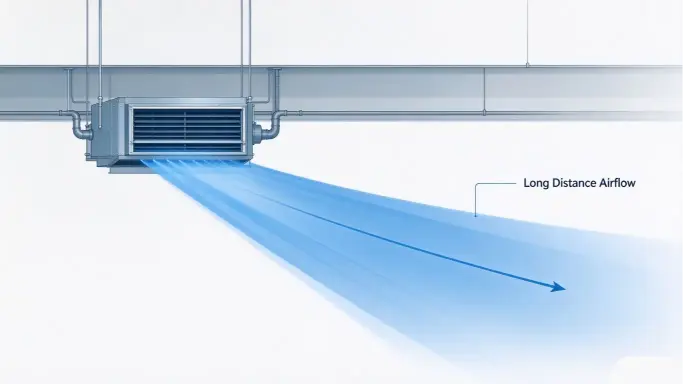
In a 9-meter-high warehouse, this matters enormously. Cold air is heavier than warm air, so if it is released gently it sinks only near the unit. By projecting the air horizontally at speed, the jet travels across the hall, gradually sinks as it slows, and blankets the occupied zone below. This is what makes a few suspended AHUs able to cover a 30 × 24 m floor without a forest of ducting.
6. Case Study: Textile Warehouse Cooling for a 30 × 24 × 9 m Building
The following is a representative design based on a real warehouse cooling application.
Textile Warehouse Cooling-Project conditions
| Parameter | Value |
| Warehouse size | 30 m (L) × 24 m (W) × 9 m (H) |
| Warehouse volume | 6,480 m³ |
| Outdoor condition | 35–40°C |
| Target indoor temperature | 30°C |
| Cooling source | 120 kW industrial chiller, 7°C chilled water |
| Air distribution | Suspended AHUs with insulated water piping |
Textile Warehouse Cooling-How the solution works
- A central 120 kW industrial chiller supplies 7°C chilled water through insulated piping to the suspended AHUs.
- Suspended AHUs are mounted under the ceiling and distributed to cover the full 24 m width and reach across the 30 m length.
- Each AHU draws warm warehouse air, cools it across the chilled-water coil, and projects the cold air across the hall to keep the whole volume around the 30°C target.
- The system provides cooling only, with no humidification or fresh-air load, which keeps it simple, low-cost, and focused on the actual requirement.
7. How to Design Your Textile Warehouse Cooling System in 6 Steps
Use this six-step method to design and verify a chiller + AHU system for your own warehouse.
Step 1 — Calculate the total cooling load
Determine the heat gains: building envelope (roof and walls, which dominate in a 9 m high warehouse), ventilation/infiltration, lighting, equipment, and people. The roof is usually the biggest source in a hot climate.
Step 2 — Define the air change and flow rate
For a large warehouse, select a number of air changes per hour that achieves the target temperature with the jet distribution. Higher air change rates mean more AHUs or larger units.
Step 3 — Select and lay out the suspended AHUs
Choose units with the right cooling capacity and throw distance for your hall dimensions. Space them so their jets overlap and cover the floor area evenly. Suspending them under the ceiling keeps the floor clear for racking and forklifts.
Step 4 — Match and verify the chiller capacity
Size the chiller to the total cooling load with a safety margin, and confirm it delivers the 7°C chilled water the coils are designed for. Account for ambient conditions that reduce chiller capacity in hot climates.
A practical capacity check for this project: with 120 kW of cooling and a typical air-side temperature rise of about 14°C (supply ≈16°C, return ≈30°C), the system can handle roughly 25,500 m³/h of air — about 4 air changes per hour for a 6,480 m³ warehouse. That is a sensible rate for holding a large, well-sealed warehouse near 30°C. Confirm the exact figure with your engineer using the real envelope and occupancy data.
Step 5 — Design the water piping
Run insulated chilled-water supply and return piping from the chiller to each AHU, sized for the flow each unit needs. Provide a circulation pump with the required head.
Step 6 — Add controls
Use a controller to hold the supply water temperature and allow zone-based control of the AHUs, so the warehouse stays near 30°C without overcooling or wasting energy.
8. FAQ: Textile Warehouse Cooling
Q1: Why use chilled water instead of direct expansion (DX) cooling for a warehouse?
A central chiller serves many AHUs with one efficient machine, is easier to maintain, and avoids running many separate refrigerant systems in a large hall.
Q2: Why are suspended AHUs better than standard diffusers in a high warehouse?
Suspended AHUs with jet nozzles project cold air across tens of meters, so a few units cover a large floor area without long ductwork. Standard diffusers only cool the area directly beneath them.
Q3: Is 30°C a reasonable target for textile warehouse cooling?
Yes. For storage and worker comfort in a hot climate, holding the space at around 30°C when it is 35–40°C outside is a practical, cost-effective target — substantially cooler than ambient without the energy cost of a full 20°C office environment.
Q4: Is a 120 kW chiller right for my warehouse?
It depends on your envelope, insulation, and occupancy. For a 6,480 m³ warehouse it supports roughly 4 air changes per hour at a 14°C temperature rise, which is a reasonable starting point — but verify with a load calculation for your exact building.
Q5: Do I need humidification as well?
Not necessarily. For cooling-only requirements, a chilled-water coil lowers both temperature and a small amount of humidity. Whether you need active humidification depends on the fabric and the process.
Q6: Can the system be expanded later?
Yes. Because AHUs are connected by a central chilled-water loop, you can add more units and increase chiller capacity as the warehouse grows.
9. Conclusion
Cooling a large textile warehouse in 35–40°C heat is a real engineering challenge, and it is best solved with a central industrial chiller + suspended AHUs. A 120 kW chiller supplies 7°C chilled water; the suspended AHUs project cold air across the hall to hold the space around a comfortable and fabric-safe 30°C. The approach is efficient, low-cost, and easy to install without long ductwork — a proven method for reliable textile warehouse cooling.
If you are looking for a reliable warehouse cooling solution, DAEKE provides customized chiller and AHU systems for various industries. Contact us for free technical support and quotation.